Peptide Testing: Hplc & Mass Spec Purity Overview Apex
Throughout solid-phase synthesis, each amino acid coupling step has a yield of about 99-- 99.8%. When a coupling falls short, the expanding chain is capped to stop further elongation of the inaccurate sequence. The outcome is a peptide that's much shorter than meant-- missing several amino acids.Mass Spectrometry (ms): Identification Verification
- Peptide testing is the logical process used to verify that a research peptide is both pure and properly recognized.Recurring non-peptide elements can alter assay analysis, misshape peptide content calculations, and make complex great deal qualification.For instance, prior to a peptide medicine can go into human tests, its maker should show the identification, purity, strength, and safety and security of the peptide via validated logical approaches.
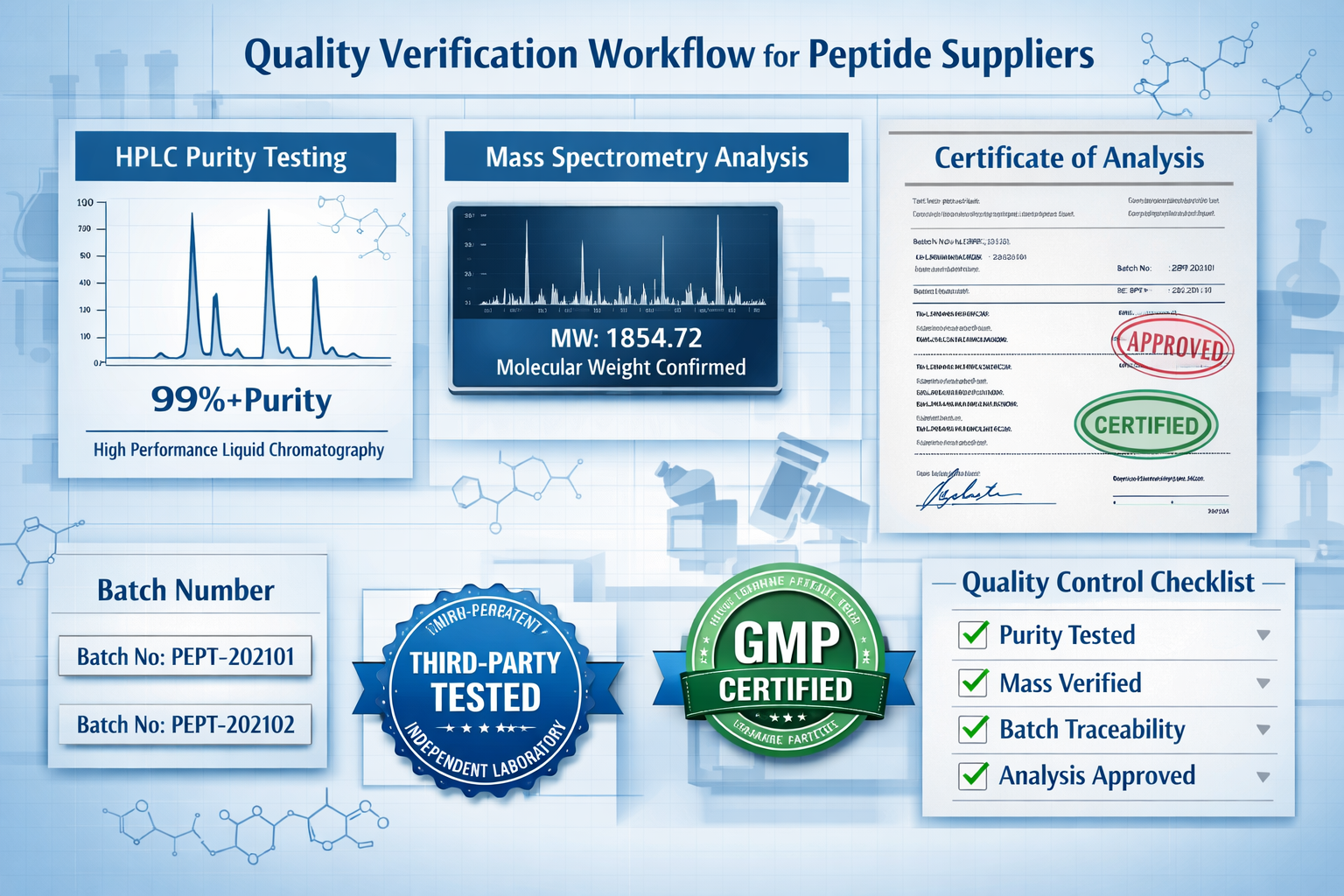
Matching HPLC, laboratories use Mass Spectrometry (usually coupled as LC-MS) to verify the peptide's molecular weight and sequence identity. Mass spectrometry supplies molecular verification by spotting the specific mass of the peptide and any type of co-eluting species or abbreviated series with high accuracy. Together, HPLC and MS data enable analysts to validate that the peptide's composition matches what it needs to be (right amino acid sequence and expected alterations) and that no significant pollutants are present.
A useful assay determining downstream signaling-- or a structural research making use of NMR or X-ray crystallography-- demands the highest possible purity offered. Crystallographers in particular often call for ≥ 98% pureness due to the fact that even small pollutants can avoid crystal formation or introduce disorder into the crystal latticework. As particles leave the column, they pass through a detector-- usually a UV detector readied to 214 or 220 nm, wavelengths where the peptide bond takes in light highly. The detector documents just how much UV light is taken in over time, creating a graph called a chromatogram. This overview breaks down what pureness actually indicates in peptide chemistry, how it's gauged, what the contaminations are, and how to review the documentation that shows a peptide is what it claims to be.What Peptide Screening Can And Can Not Prove
At Maxed Out Compounds, every item we supply includes a clear testing document and clear documents. Our goal is to support scientists with high-purity, verified compounds that satisfy the demands of modern clinical research study-- absolutely nothing more, absolutely nothing less. Independent, third-party testing plays a necessary function in ensuring neutrality and precision. By utilizing external laboratories for confirmation, vendors get rid of prejudice and promote scientific integrity. It's an added action that gives scientists self-confidence that each peptide satisfies constant, proven requirements. This grade suits the majority of artificial Biotechnology insemination research study applications-- receptor binding assays, enzyme activity studies, and cell culture experiments.In simple terms, a peptide listed as 95% pure consists primarily of the target peptide (95%), with the staying ~ 5% made up of contaminations. These contaminations can include things like shortened or trimmed series, deletion versions, oxidized deposits, or other small side-products from the synthesis procedure. Peptides are widely made use of in the clinical looks, cosmetics, and biomedical areas due to their distinct biological task and broad application capacity. Nevertheless, the top quality of peptide items straight influences https://writehollow.com/s/W1u0wGG3bsnbppYvjuaBK their performance and safety, making exact top quality testing services important.